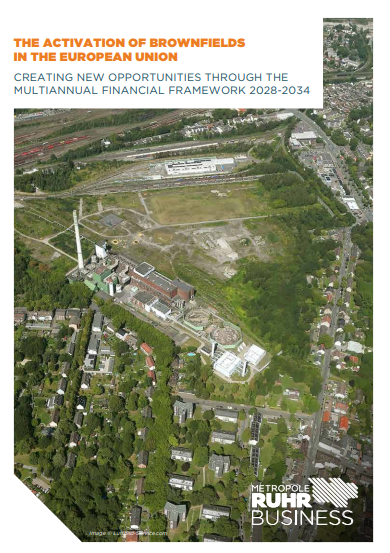
The Brno Metropolitan Area is one of thirteen European regions that participated in the creation of the policy paper “The Activation of Brownfields in the European Union: Creating New Opportunities through the Multiannual Financial Framework for 2028–2034.” The document was created under the leadership of the Ruhr region and its economic development agency.
The participating regions are united by the issue of brownfields, i.e., unused or abandoned sites, often former industrial, agricultural, or military facilities that remain unused despite the existence of specific project plans and investor interest. However, their transformation is often hampered by high site preparation costs, complex property relations, and administrative barriers.
You can find the policy paper under this link.
Within the policy paper, the Brno Metropolitan Area identifies several fundamental obstacles to brownfield regeneration. The main challenges include uncertain property and institutional conditions, fragmented or persisting public ownership, and complex land valuation processes. In addition, investors often prefer greenfield development over the more demanding regeneration of brownfield sites. In the Czech context, a significant barrier is also the absence of a specialised institution responsible for the systematic management and coordination of brownfield policy.
As examples of proven approaches, the Brno Metropolitan Area refers to the transformation of the former military canteen into Kadetka Park and the redevelopment of the former heating plant site of Teplárny Brno into the Skála Community Centre. These projects demonstrate that coordinated public sector action, support from national funding programmes, and strategic planning can lead to the successful transformation of neglected sites.
The Brno Metropolitan Area faces substantial challenges in brownfield regeneration, particularly in Brno, Vyškov, Ivančice, and Bučovice. In this context, the policy paper emphasises that more targeted and flexible EU financial instruments, especially for early-stage project phases such as land acquisition, demolition, and site preparation, would reduce the financial burden on municipalities and enable the implementation of strategically significant projects.
Thirteen regions have therefore published a joint document setting out requirements for the introduction of more specific and targeted instruments in the upcoming EU multiannual financial framework for 2028–2034 and cohesion policy. The recommendations are based on surveys and practical experience of the regions involved and respond to the most common barriers to brownfield revitalization.
The main requirements include:
• Early-stage financing as a separate component – creation of a European support mechanism focused on land acquisition, planning, demolition, and soil remediation.
• Strengthening institutions through public development companies – creating structures that will help municipalities and regions manage the complex processes of site preparation and property rights issues.
• Increasing the flexibility of existing EU programs – setting funding criteria to better reflect the environmental, economic, and social benefits of site regeneration.
• Specialized tool for strategic land acquisition – integration of land acquisition support into European programs in a way that allows public actors to act strategically while limiting land speculation.
The participating regions also declare their readiness to share data, expertise, and practical experience and to engage in structured dialogue with EU institutions. The aim is to create financial and institutional conditions that will enable the full potential of brownfields to be exploited.
List of participating regions:
The Ruhr (Germany, initiator), Asturias (Spain), Brno Metropolitan Area (Czech Republic), Catalonia (Spain), Grand Est Region (France), Metropolis GZM (Poland), Moravian-Silesian Region (Czech Republic), Savinja-Šalek Region (Slovenia), Upper Austria (Austria), Usti Region (Czech Republic), Walloon Region (Belgium), Western Macedonia (Greece) and Zasavje (Slovenia).
Register your e-mail address to receive regular updates from the Brno Metropolitan Area.